What to expect after your offer is accepted, including how to handle inspection findings, the repair negotiation, and appraisal gap risk.
Your offer is accepted. The seller has signed. Now the contract clock starts, and two separate processes need to clear before you close: the home inspection and the lender's appraisal. Both can derail a deal. Both can also be handled cleanly if you know what's coming.
This guide walks through both processes specifically for Woodbury MN move-up buyers. What to expect, what to watch for, how to handle common findings in the late-1990s and 2010s housing stock that dominates Woodbury, and how to manage appraisal-gap risk in a competitive offer.
It assumes you've already worked through Deciding to Buy in Woodbury MN, Getting Pre-Approved, and Searching for a Home in Woodbury MN.
Darin Bjerknes has been selling east metro homes for 20+ years. The sections below are the practical playbook for the under-contract phase.
The home inspection
A home inspection is a paid third-party visual assessment of the home's condition. The inspector spends 2 to 4 hours walking the property, opening accessible systems, taking photos, and producing a written report.
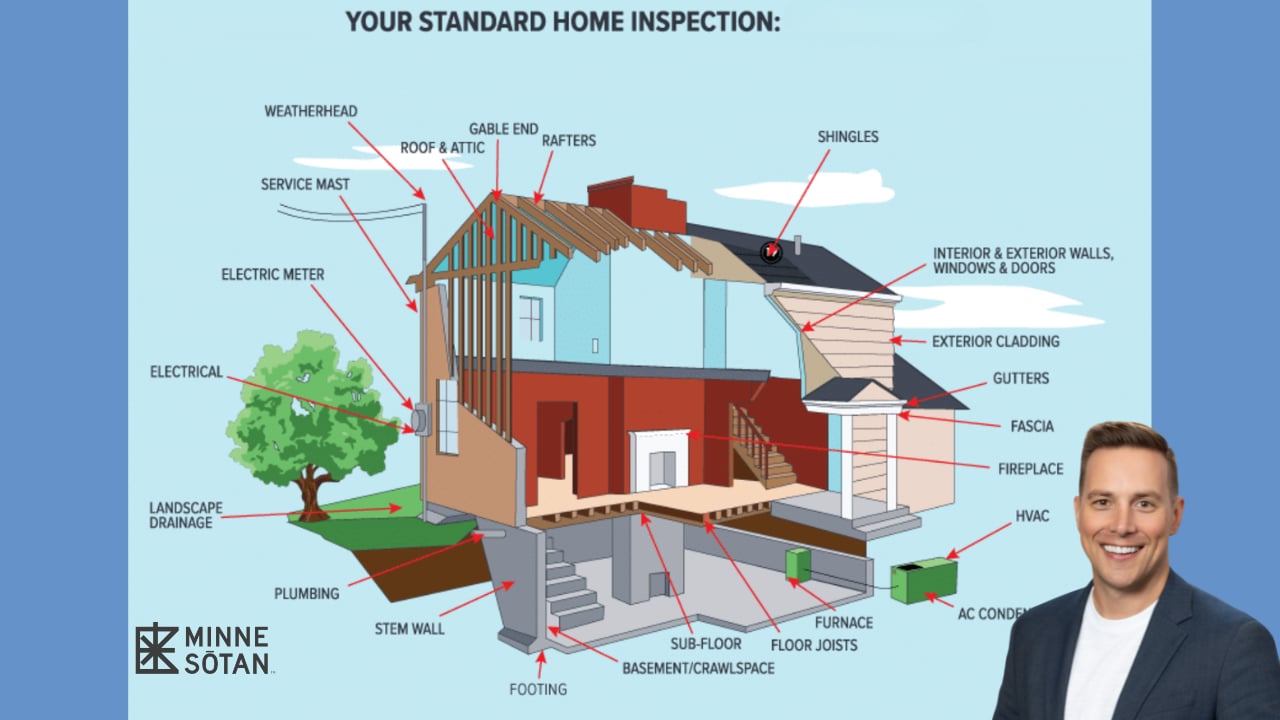
What's inspected: roof, attic, exterior, foundation, basement, plumbing, electrical, HVAC, appliances, windows, doors, smoke and CO detectors, drainage, grading, and visible structural elements.
What's not inspected: anything inside walls or behind finished surfaces, septic systems (separate inspection), wells (separate inspection), pools and hot tubs (often separate), chimneys past visual (often separate sweep), pests (separate WDI inspection if needed), radon (separate test), mold (separate test), and lead paint (separate test for pre-1978 homes).
For Woodbury homes, the most common add-on inspections are radon (Minnesota has high radon levels), and for homes built before 1978, lead paint. Most Woodbury master-planned community homes are built post-1978, so lead paint is rarely an issue.
Cost in the Twin Cities east metro: $400 to $700 for a standard 2,500-3,500 square foot Woodbury home. Larger or more complex homes run higher. Radon testing adds $125 to $200. Sewer scope adds $200 to $300.
How to choose a Woodbury home inspector
Not all inspectors are equal. Some are former contractors who know the trades cold; others are recently certified and learning on your dime. The inspector you hire affects what gets caught.
What to look for:
- InterNACHI or ASHI certification at minimum. These are the two recognized industry credentials.
- 5+ years inspecting in Minnesota. Local experience matters because Minnesota homes have specific issues (frost heave, ice dams, basement moisture, radon) that out-of-state experience may not cover.
- Sample report available. Ask for a sample inspection report before hiring. A good report has detailed photos, clear severity ratings, and specific recommended actions. A bad report has generic boilerplate language and unclear next steps.
- Allowed at the inspection. Some inspectors don't want clients on-site. Skip them. The best inspections happen with you walking through alongside the inspector, asking questions in real time.
Darin maintains a short list of east metro inspectors he's worked with for years. After 20+ years, he knows which ones catch what others miss and which ones are reliable on report turnaround.
What to expect on inspection day
A typical inspection in Woodbury runs 3 to 4 hours for a 2,500-square-foot home. Plan to arrive at the start, walk through with the inspector for the last 30 to 60 minutes, and ask questions about anything flagged.
The inspector will work systematically: exterior first, then roof and attic, then interior room by room, then mechanical systems (HVAC, plumbing, electrical), then basement and foundation. They'll take 100 to 300 photos. Most inspectors deliver the written report within 24 to 48 hours.
What you do during the inspection:
- Walk the property at the start. Look at the lot, the drainage, the neighbors' houses, and the street feel during a non-showing day.
- Be present at the end when the inspector summarizes findings. This is when the most useful information surfaces, in conversation rather than the written report.
- Take your own photos and notes of anything you want to remember, especially anything that wasn't obvious during the showing.
- Ask about repair costs in rough terms. Most inspectors won't give exact numbers but can tell you "this is a $5,000 issue, not a $50,000 issue."
Reading the inspection report
A typical Woodbury inspection report runs 40 to 80 pages. Most of it is photos and standard observations. The part that matters is a summary section, usually in the first few pages, that lists findings categorized by severity.
The categories typically are:
- Safety concerns (immediate hazards: missing GFCIs, exposed wiring, gas leaks)
- Major defects (significant issues that affect function or value: roof needing replacement, failing HVAC, foundation movement)
- Maintenance items (normal wear-and-tear that needs attention: caulking, paint, minor leaks)
- Cosmetic (appearance issues with no functional impact)
For move-up buyers, the move is to focus on safety concerns and major defects. Maintenance items are normal for any home and don't typically drive negotiation. Cosmetic items aren't part of the inspection conversation at all.
A good rule: any single item under $500 to fix probably isn't worth negotiating. The seller is more likely to walk than to nickel-and-dime over small issues. Save your negotiation leverage for items that materially affect value.
Common findings in Woodbury homes
What gets flagged depends on when the home was built and what neighborhood it's in.
Older Woodbury homes (1980s through early 2000s): Wedgewood, Stonemill Farms (2002), and similar vintages typically show aging HVAC (furnaces 15-25 years old, AC units 15-20 years old), original water heaters at end-of-life, original roofs at year 20-25, and possibly outdated electrical panels. None of these are dealbreakers individually, but stacked they can mean $20K to $40K of replacement work coming in the next 5 years.
Mid-2000s and 2010s Woodbury homes: Bailey's Arbor (built starting 2004), Dancing Waters, Powers Lake Circle infill (around 2013), and similar newer construction tend to have cleaner mechanicals but sometimes show settling cracks, minor drainage issues, builder shortcuts in basement waterproofing, and warranty issues for sellers in the 1-to-10-year window.
Lake-adjacent homes (Powers Lake, Markgrafs Lake): Foundation moisture, sump pump performance, and drainage grading are all worth extra attention. A home with lake frontage or lake exposure should have a robust sump system and clear drainage paths.
HOA-governed homes: Confirm any pending HOA assessments or upcoming community-level repairs (roof replacements, road resurfacing, amenity upgrades). Sellers should disclose, but sometimes details are missing. Worth a separate conversation with the HOA before closing.
Radon results: Minnesota has the highest radon levels in the country. A radon test is a cheap add-on ($125 to $200) and catches a real safety issue. EPA's action level is 4.0 pCi/L. Above that, mitigation runs $1,500 to $2,500 and is usually a seller-paid item if the buyer requests.
The repair negotiation
After the inspection report is in, you have a window (typically 5 to 10 days from offer acceptance, depending on how the contract was written) to either accept the home as-is, request repairs or credits, or walk away.
The three move-up buyer paths forward:
Accept as-is. If the inspection confirms the home is in expected condition with only minor issues, sign off and proceed to appraisal. Don't try to renegotiate price after a clean inspection. It poisons the relationship with the seller and can blow up the deal.
Request repairs. Itemize specific repairs you want the seller to complete before closing. The seller can agree, counter (offering a credit instead, or a different scope), or refuse. In a balanced market, sellers usually agree to material safety issues and major defects.
Request a closing credit. Instead of asking the seller to fix items, ask for a dollar credit at closing that lets you handle the work yourself with your preferred contractor. For move-up buyers, this is often the better path because you control timing and quality.
What not to do:
- Don't bring up cosmetic items. It signals you don't understand what the inspection is for.
- Don't ask for credits proportional to the asking price. Negotiate based on the actual cost of the issue, not as a percentage of price.
- Don't ask for everything. Pick the 3 to 5 most material items and let the rest go.
- Don't threaten to walk unless you're actually willing to walk. Sellers can call the bluff.
If the seller refuses to address material issues, you have a decision: accept and proceed, walk away (and recover your earnest money per the contract terms), or counter with a smaller request. Darin walks through the specific scenario with each client.
The appraisal
Separate from the inspection, your lender orders an appraisal. The appraisal is a third-party valuation that confirms the home is worth at least the loan amount.
What the appraiser does: visits the property, measures the square footage, photographs interior and exterior, evaluates condition, and compares to recent comparable sales (comps) in the Woodbury market. Produces a written appraisal report with a final value.
Timeline: typically 7 to 14 days from order. The appraiser schedules with the listing agent and may not need the buyer present.
The three outcomes:
- Appraises at or above purchase price. The deal proceeds normally. Most appraisals come in at or near contract price.
- Appraises below purchase price (low appraisal). The lender will only finance based on the appraised value, not the contract price. This creates an "appraisal gap" that has to be resolved.
- Appraises significantly above purchase price. Rare but happens occasionally. Doesn't change the contract; you just got equity day-one.
Handling an appraisal gap
In competitive Woodbury markets where homes sell above asking, appraisal gaps are a real risk. If you offered $850K and the home appraises at $830K, you have a $20K gap.
Three ways to resolve:
Bring more cash to close. You cover the gap with additional down payment. Most common path for move-up buyers with strong cash reserves.
Renegotiate price. Ask the seller to lower the contract price to the appraised value. Sellers in competitive markets often refuse because they have backup offers willing to cover the gap.
Walk away. If your contract has an appraisal contingency, you can terminate and recover earnest money. If you waived the appraisal contingency to make your offer competitive, you may forfeit earnest money instead.
Appraisal gap coverage in the offer. Sophisticated move-up buyers in competitive Woodbury price bands sometimes write offers with explicit appraisal gap language: "Buyer agrees to cover up to $X above appraised value." This makes the offer more competitive while capping the buyer's downside. Darin and Adam Roloff structure this language together when the situation calls for it.
Working with Darin during inspections and appraisals
The under-contract phase is where Darin's coordination role matters most. Inspector scheduling, walking the inspection alongside you, reading the report and identifying which items matter, drafting the repair request or credit ask, negotiating with the listing agent, coordinating the appraiser's access, and structuring appraisal-gap language if needed. Each of these is a 30 to 60 minute task that, multiplied by every deal, is what 20+ years of east metro practice looks like.
For Woodbury move-up buyers, that means a known short list of trusted inspectors, candid feedback on which inspection findings are real issues vs. boilerplate, repair negotiation framing that keeps the deal alive, and appraisal-gap structuring when the situation requires it.
If you're thinking about buying in Woodbury, set up a time to chat, or call 612-702-5126.
Inspections and appraisals FAQ
What is a home inspection? A paid third-party visual assessment of a home's condition, covering roof, foundation, mechanicals, electrical, plumbing, and major systems. Typically takes 2 to 4 hours and produces a written report within 24 to 48 hours.
How long does a home inspection take? 2 to 4 hours for a typical Woodbury home. Larger homes (4,000+ square feet) or older/complex properties can run 5 to 6 hours.
How much does a home inspection cost in Woodbury MN? $400 to $700 for a standard 2,500-3,500 square foot Woodbury home. Add-ons like radon ($125-$200) and sewer scope ($200-$300) are common.
What does a home inspection cover? Roof, exterior, foundation, basement, plumbing, electrical, HVAC, appliances, windows, doors, smoke and CO detectors, drainage, grading, and visible structural elements. It does not cover septic, wells, pools, chimneys past visual, pests, radon, mold, or lead paint without separate add-on inspections.
What is the difference between an inspection and an appraisal? An inspection is a buyer-ordered assessment of the home's physical condition. An appraisal is a lender-ordered valuation that confirms the home is worth at least the loan amount. Both happen during the under-contract period but serve different purposes.
What is an appraisal gap? When the appraised value is less than the contract purchase price, the difference is the "appraisal gap." The lender only finances based on the appraised value, so the buyer either covers the gap with additional cash, renegotiates with the seller, or walks away.
Can I waive the inspection? You can, but you shouldn't unless you're paying cash and have specific reasons. Inspection waivers are sometimes used in highly competitive Woodbury offers to win against other buyers, but they put the buyer fully at risk for unknown issues.
What is the inspection period timeline? Typically 5 to 10 days from offer acceptance, depending on how the purchase agreement was written. Within that window, the buyer schedules and completes the inspection, reviews the report, and either accepts the home, requests repairs or credits, or terminates.
What if the inspector finds major issues? You have options. Accept the home as-is, request repairs from the seller, request a closing credit equal to the cost to fix, or walk away (recovering earnest money if your contract allows). Darin walks through the specific scenario with each client.
What is typical for older vs. newer Woodbury homes? Older homes (1980s through early 2000s) often show aging HVAC, water heaters, and roofs nearing replacement age. Newer homes (mid-2000s and later) tend to have cleaner mechanicals but sometimes show settling cracks, drainage issues, or builder warranty items. Lake-adjacent homes deserve extra attention on foundation moisture and sump performance.